Pvt. Stafford Rimes (2 January 1918 – 21 November 1944)
452nd Anti-Aircraft Artillery Automatic Weapons Battalion
By Samantha Froemming
Early Life
Stafford Rimes was born on January 2, 1918, in Lake City, FL, to James and Idella Rimes.1 James and Idella married on December 26, 1909, in Mason, Columbia County, FL.2 They had a total of six children together: Vasco (1911), Wilbur (1913), Erma (1916), Stafford, Idabell (1923), and Coram (1926).3 James Rimes Sr., seen here, acquired land in Mason, FL, sometime between 1900 and 1910, where he and his family lived and worked as farmers.4 This is extraordinary as African American families did not often own land in the early twentieth century, especially in the Jim Crow South. African American communities faced racial discrimination from Florida’s Black Codes, which, among other things, hindered the economic opportunities for Black families. Together with threats of violence, including lynchings, most African Americans could not acquire property or a measure of stability in the South.5
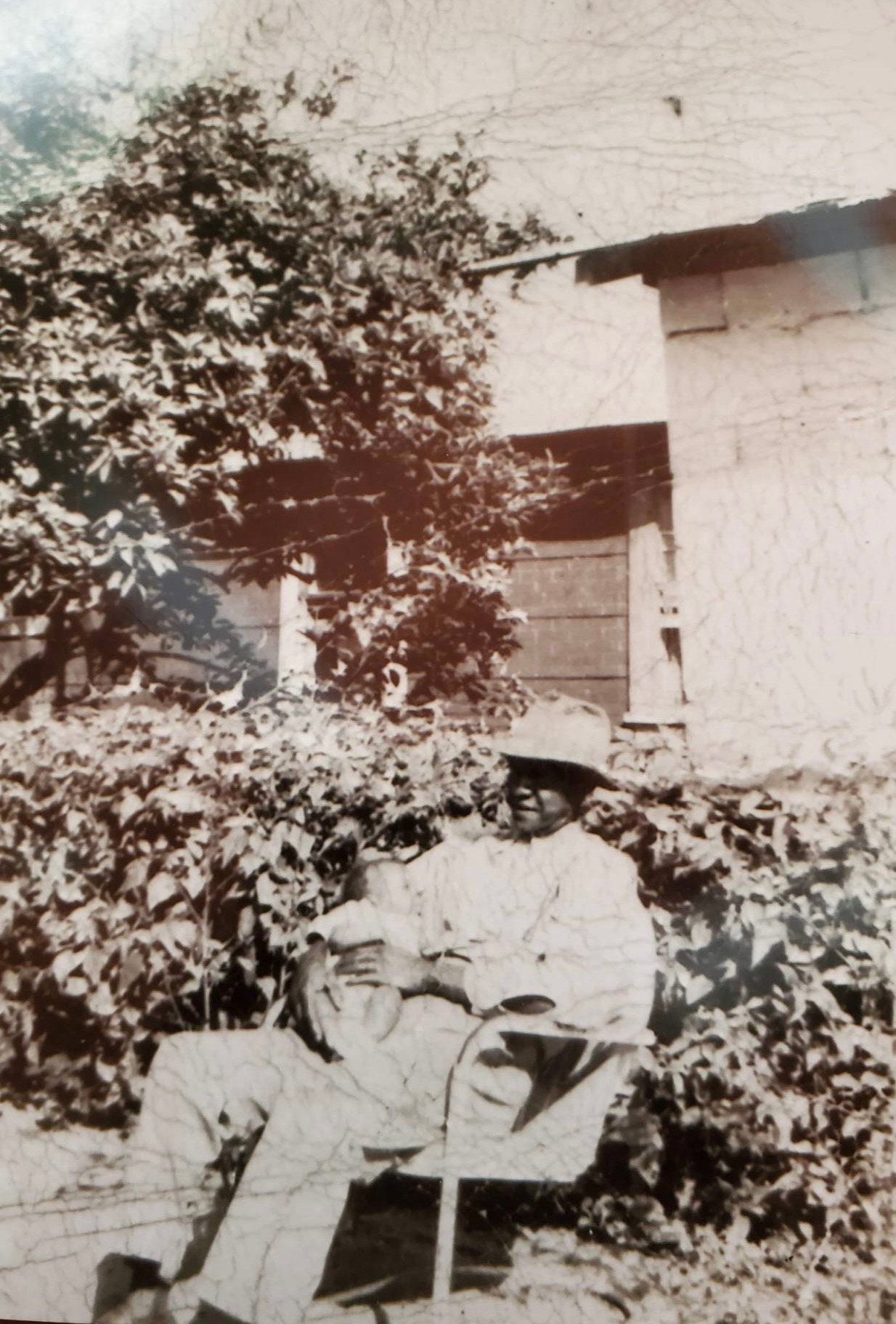
Stafford’s father, James, likely inherited his entrepreneurial drive from his own father, Jasper Rimes. Jasper owned a farm in Columbia County before relocating to Lake County in 1918, where he and his sons operated a citrus farm and a produce store; they expanded their work through truck farming until his death in 1925.6 Their efforts unfolded during a period when Florida’s citrus industry reached its height in the late nineteenth and early twentieth centuries, a boom that enabled land‑owning families to build prosperous agricultural enterprises despite the state’s relatively small population. Across the South, truck farming supported post–Civil War crop production, and grower associations continued to develop into the early twentieth century. Florida’s extensive citrus output strengthened this system, first via horse-drawn carts and later with trucks increasingly transporting fruit to distant markets, replacing railroads in many areas, and allowing growers to deliver fresh produce rapidly to a wider range of communities.7
In 1927, Stafford’s mother, Idella, died, which must have been a devastating loss for Stafford and the whole family. A year later, James remarried, on October 14, 1928, to Lillie Mae Carter.8 Together they built a large blended household, welcoming six more children: James (1929), Mozella (1931), Mercina (1936), Geraldine (1937), Hazel (1938), and Randolph (1940), giving Stafford eleven siblings.9 Stafford’s grandmother, also named Idella, joined her son James Sr.’s household after her husband’s death in 1925.10 James Jr. described memories of the two women living in their household, his mother and grandmother, since Idella lived among her grandchildren until her death in 1939, anchoring a multigenerational family during years of upheaval and transition.11
The growing Rimes family navigated a turbulent time in Florida. Two major hurricanes in 1926 and 1928 battered the state, and soon afterward, Mediterranean fruit flies swept through citrus groves, triggering widespread quarantines and crippling agricultural communities.12 These crises strained families across Florida, including the Rimes, and likely led them to seek new opportunities. Between 1930 and 1935, James and his family left Mason in Columbia County and settled on 1026 East Main Street in Leesburg, Lake County, moving closer to the rest of James Sr.’s siblings.13
As African Americans in the deep Jim Crow South, the Rimes family had to be committed to education to ensure all their children could read and write; Stafford attended the Lake Training School in Leesburg and achieved a grammar school education.14 Between 1935 and 1940, the older Rimes siblings: Vasco, with his wife Mary and two sons, Wilbur, Erma, and Stafford, moved out of the family house to settle together, likely a few homes away. Vasco worked at a car wash; Mary and Erma worked as maids in private homes. Stafford and Wilburg worked as helpers in auto service station garages in Leesburg, where Stafford also handled parking lot duties and served as a filling attendant.15 In much of the twentieth century, gas station attendants filled customers’ tanks and performed small services, including washing windows and checking fluid levels while they waited. Customer service and safety motivated gas stations to offer services that kept automobile owners in their cars during refueling.16
On October 16, 1940, the three older Rimes brothers, Vasco, Wilbur, and Stafford, registered with the draft board in Tavares.17 Evidence indicates that between his draft registration and his enlistment that Stafford started a family, living with his partner and their child, in Okahumpka, FL.18
Military Service
Twenty-four-year-old Stafford enlisted at Camp Blanding, FL, in December 1942, just months after his brother Wilbur joined the Army on February 18, 1942, at Fort Benning, GA.19 The Rimes brothers were among more than twelve million Americans who served in World War II, including more than a million African Americans. African American soldiers played a central role in the military effort, even as their experiences diverged sharply from those of white servicemen. They served in fully segregated units, with only three percent of these units outfitted for combat. Most served in essential support roles, sometimes behind the lines, but often near or in the midst of fierce battles. Black men served as stewards in the Navy, engineers in the Army’s Quartermaster Corps, and laborers in other Army units tasked with crucial duties, including the burial of the dead.20
From the outset, racial violence marked the training of African American soldiers on US bases. The tension between fighting for democracy abroad and confronting discrimination at home deepened their sense of injustice, leading many to view themselves as “half-American;” they felt committed to a nation that denied them full citizenship.21 This contradiction found expression in the “Double V Campaign,” launched by the Pittsburgh Courier in early 1942, which called for victory against fascism overseas and equality at home. The inequalities African Americans faced in the United States carried into their service abroad, where segregation and racial violence within the Armed Forces continued to shape their daily lives.22
Within this context of limited combat opportunities and systematic discrimination, Stafford joined the 452nd Anti‑Aircraft Artillery Automatic Weapons Battalion, one of the few all‑Black combat units. The 452nd had fewer than 1,000 soldiers, including support staff, and was the only fully mobile African American anti-artillery unit in World War II.23
The 452nd transformed from a Coastal Artillery unit into an Anti-Aircraft Artillery unit after World War I. Coastal Artillery units during World War I operated as semi-mobile, fixed batteries on coastal fortifications to lay sea mines in defense against ships. As its own branch, the Coastal Artillery Corps (CAC) organized and manned other types of artillery, including anti-aircraft. The US Army assigned African Americans to some Coastal Artillery units during World War I because these fixed units operated far away from the front line, but it still allowed for African Americans in combat units.24 Following the National Defense Act of 1920, the Army began redesigning many CAC units into engineering and anti-aircraft formations. As airpower advanced during the final years of the interwar period, it steadily reduced the importance of traditional coastal defense missions, and by the time the US entered World War II, CAC faced a significant demand for these anti-aircraft artillery units.25
The 452nd activated as an anti-aircraft unit on August 1, 1942, at Camp Stewart, GA, where Stafford and his unit trained until early 1943.26 Like many military bases, Camp Stewart faced racial tensions and violence. Shortly after the 452nd completed their training, racial tensions at Camp Steward exploded. On June 9, 1943, Black soldiers and military policemen exchanged gunfire, leaving five men wounded and one military policeman dead. The clash erupted after Black units endured months of mistreatment during training. African American soldiers’ frustrations intensified when a rumor circulated that white soldiers had raped a Black woman. The event culminated with Black soldiers breaking into the battalion supply room, seizing ammunition and rifles, and a mob forming that sparked further gunfire.27
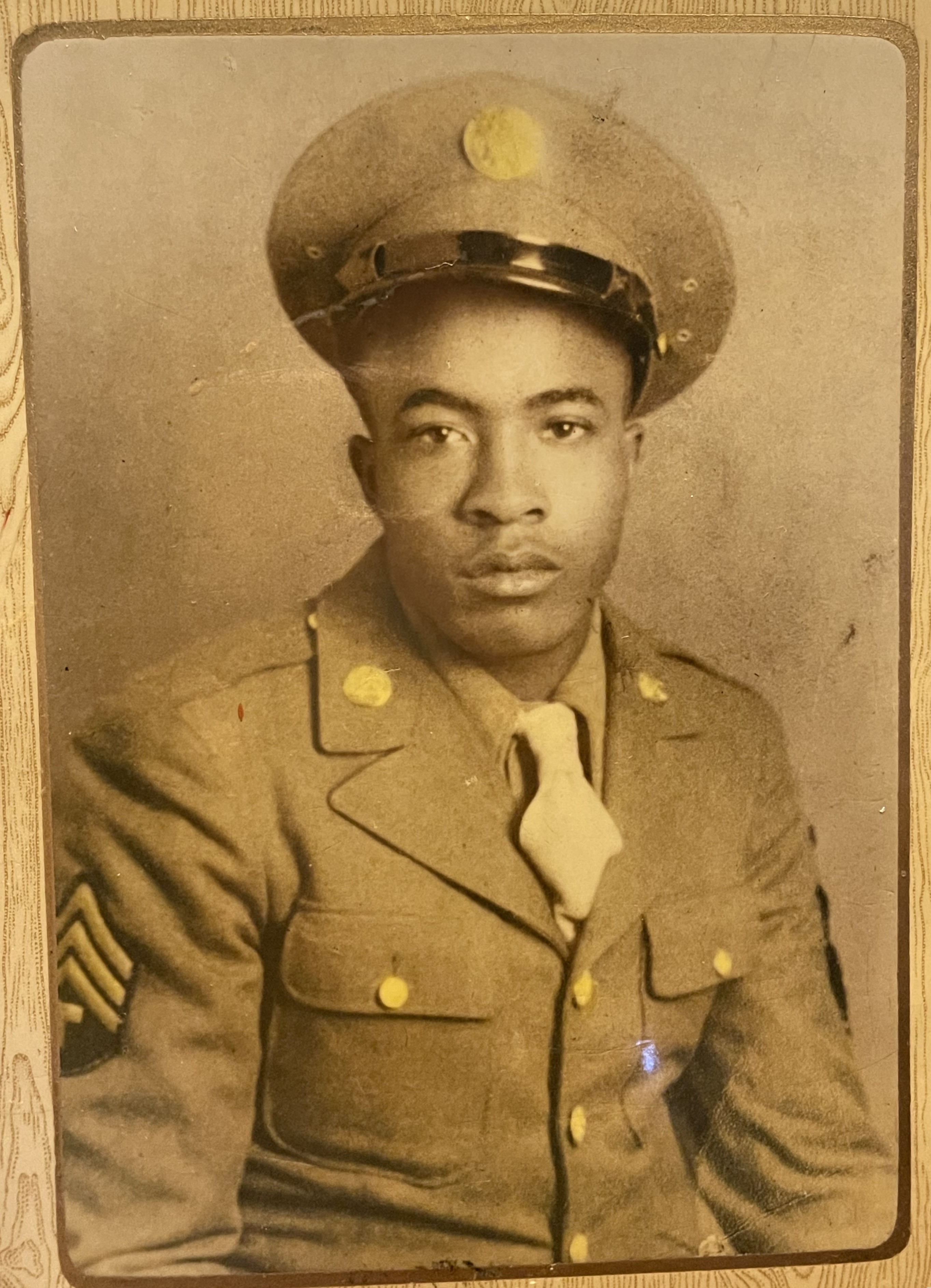
On January 10, 1943, Stafford and the 452nd battalion transferred to Camp Atterbury, IN to complete another nine months of training.28 At some point during this training period, Stafford sat for a portrait, pictured here, which he sent home to his family.29 On October 21, 1943, Stafford and his unit left New York City for the United Kingdom. They arrived in England on November 2 and began defending four coastal locations for the next seven months.30 During that time, in April 1944, Stafford spent time in a military hospital, although we do not know why or where he received treatment before he returned to service.31
The US Army assigned Stafford and his comrades to General Patton’s Third Army, alongside other Black combat units, including the 761st Tank Battalion, known as the Black Panthers.32 From 1943 to 1945, the 452nd Anti-Aircraft Artillery Automatic Weapons Battalion protected the XII Corps artillery units during operations in the European Theater.33 The battalion landed on Utah Beach between June 23-25, 1944, following the initial June 6 D-Day landings, where it protected the Omaha Beach Maintenance Area. 34 It stood among the few all-Black battalions to serve in the European Theater and was one of only two all-Black units to operate the 40 mm anti-aircraft gun.35
The Army assigned Stafford and his unit to defend American ammunition and fuel depots from German air attacks. Between August 8 and 16, their batteries moved inland to protect key road junctions, bridges, and crossroads along the Third Army’s supply routes, helping secure the flow of men and materiel as Allied forces advanced deeper into Normandy.36 On August 16, 1944, the battalion separated into First and Second Platoons, Batteries A-D, and remained under the command of Patton’s Third Army in support of the XII Corps for the rest of the war, assigned to provide protection for different field artillery battalions.37 Throughout September, the 452nd moved with the XII Corps across Northern France, liberating the city of Nancy on September 15.38 By the end of September and into October, the unit’s separated Batteries continued to target the German Luftwaffe which strafed the Third Army’s supply lines as they advanced across France and into Germany, with confirmed engagements on multiple occasions during this period.39
In November 1944, Stafford and the 452nd participated in the Allied capture of the French city of Metz.40 According to hospital records, Stafford died in a hospital on November 21, 1944, the day before the official capture of the city.41 His fatal injury came from the shrapnel of a land mine, likely laid on the outskirts of Metz, as a part of the Axis’s efforts to prevent the Allied capture of this strategically important city. Stafford was twenty-six years old. He had $12.10 and 600 Francs in his wallet; the Army sent a check for $12.10 to his family.42
Legacy
After Stafford’s death, the rest of the men of the 452nd Anti-Aircraft Artillery Battalion moved into Germany’s Rhineland with Patton’s Third Army, where they engaged the German Luftwaffe on numerous occasions. Officially, the Battalion had a confirmed total of sixty-eight destroyed German aircrafts.43 At the conclusion of the War, the 452nd served on occupation duty in Germany until it was deactivated on November 17, 1945, at Camp Myles Standish, MA.44
The 452nd received praise in the national Black press during their participation in the European Theater. On November 19, 1944, The Austin American-Statesman ran a story titled “Foxholes Fade Color Line,” noting that racial tensions eased as the men of the 452nd proved highly effective in protecting the white units and naming the battalion “one of the best negro units.”45
Stafford Rimes is buried in plot J, row 32, grave 34 at the Lorraine-American Cemetery in Saint-Avold, France, about thirty miles east of Metz.46 A letter dated April 29, 1949, to Mr. James Rimes, Stafford’s father, from the US Army shows here that the family decided he should rest with his comrades in arms in France, the nation he helped to liberate.47 Stafford posthumously received a Purple Heart for his ultimate sacrifice in battle.48 The Bradenton Herald newspaper listed Stafford’s name alongside fellow Florida servicemen who died in service in 1944. It mentioned Stafford’s name, his father James Rimes, and his residence in Lake County prior to enlistment.49

Stafford’s older brother, Wilbur Rimes, reached the rank of Tec 4 during the war and the Army discharged him on December 16, 1945.50 By 1950 he lived in Chicago with his wife and worked as a greaser in a garage.51 He later returned to Florida, settling first in Leesburg and then, in 1978, in Wildwood. He died in 1988 and rests in Columbia County, FL where a military headstone marks his grave.52 Stafford’s younger brother, James Rimes Jr., lived in Florida during the War but moved to Philadelphia, PA, with his wife, Sadie, and three young daughters in 1955 after an incident involving his white employer.[53] According to Stafford’s niece, Brenda, the family fled in their green Buick in the middle of the night, never to return.54
Both of his brothers moved away from the South as part of the Great Migration, a movement of over six million African Americans who escaped the Jim Crow South in search of economic opportunities, mostly in the North, Midwest, and the West.55 It is no surprise that James Jr. and Wilbur left their hometown of Leesburg, given Lake County’s history of racial violence and inequality. When James Rimes Jr. moved his wife and three daughters to Philadelphia in 1955, the ordeal of the Groveland Four must have haunted him.56
Just six years earlier, in 1949, a seventeen-year-old white woman and her husband accused Charles Shepherd, Walter Irvin, Samuel Greenlee and Ernest Thomas, four African American men, three of whom had served in the US military in World War II, of rape and physical assault. The white community responded with an extralegal manhunt for the four men and unleashed a wave of violence terrorizing the Black residents of Groveland, an agricultural community about fifty miles east of Orlando and about twenty miles south of Leesburg. After authorities captured them, a white mob fatally shot Thomas when he attempted to escape custody.57 The others, Greenlee, Shepherd, and Irvin, endured brutal treatment and wrongful conviction. Efforts to seek justice brought further violence: white supremacists assassinated Harry T. and Harriette Moore, prominent leaders of the NAACP involved in the case, by placing a bomb under their home on Christmas day 1951, as a warning to anyone who defended the Groveland Four.58
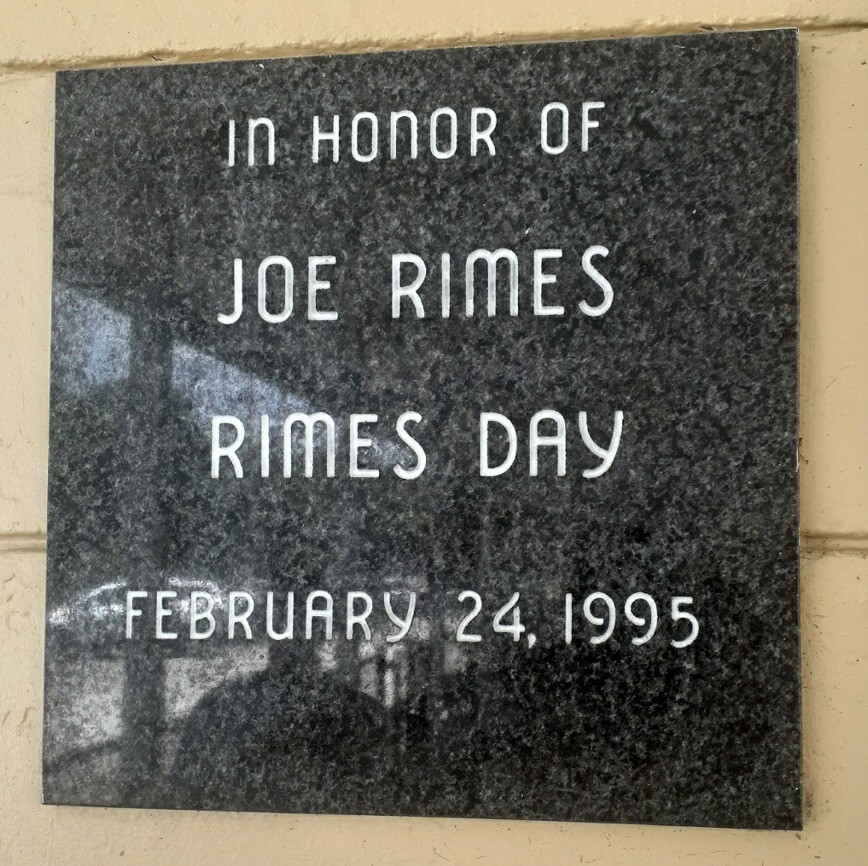
Despite this institutional and extralegal discrimination and violence they faced, the Rimes family persevered in every way. They owned land and businesses, they met the call to military service with pride, and they believed in the power of education. Joseph Rimes donated part of the land he owned to establish the Rimes Early Learning and Literacy Center in Leesburg, FL. Pictured here, his generosity is honored by a plaque that reads “In Honor of Joe Rimes: Rimes Day, February 24, 1995.”59 The elementary school still operates today.60
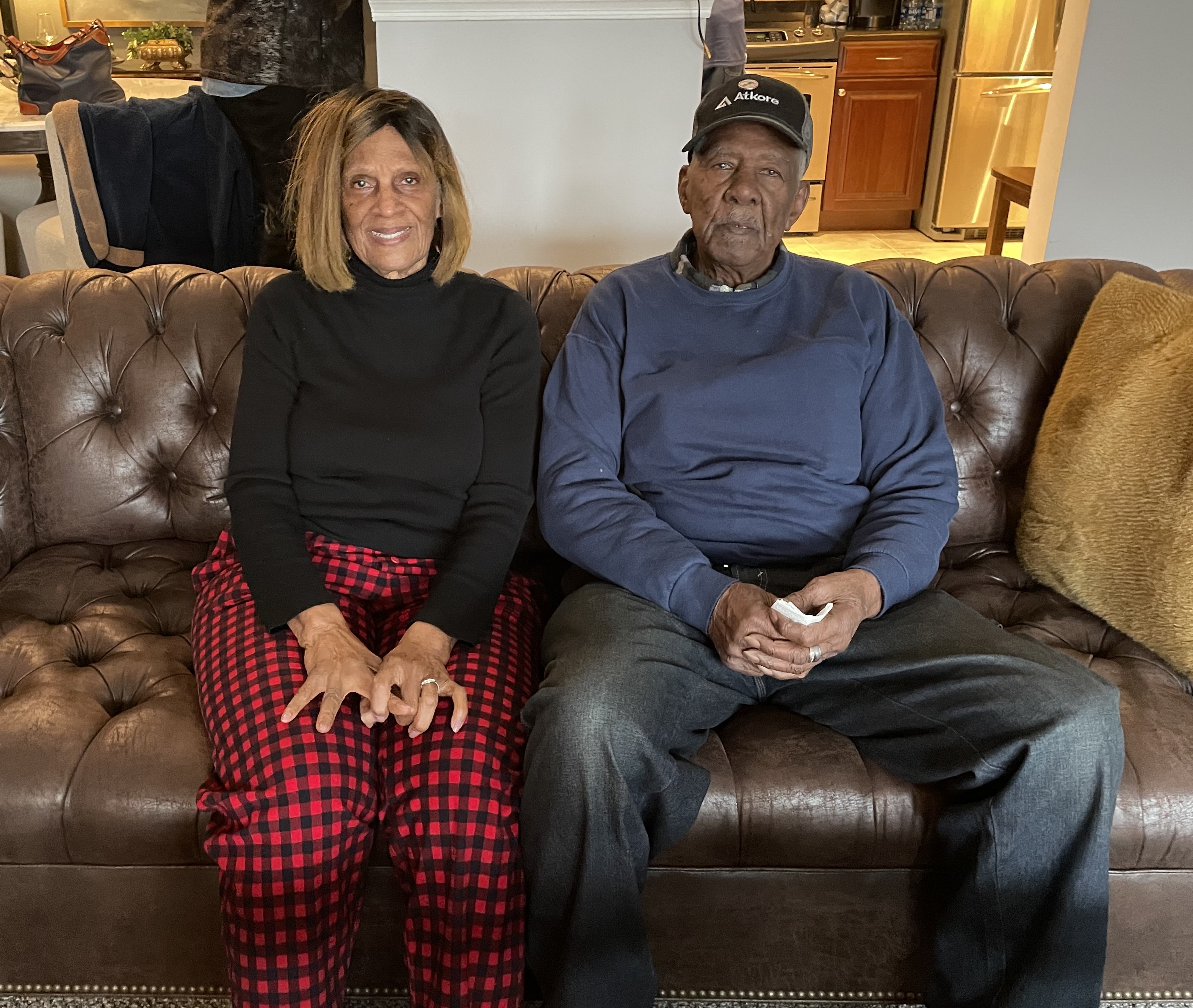
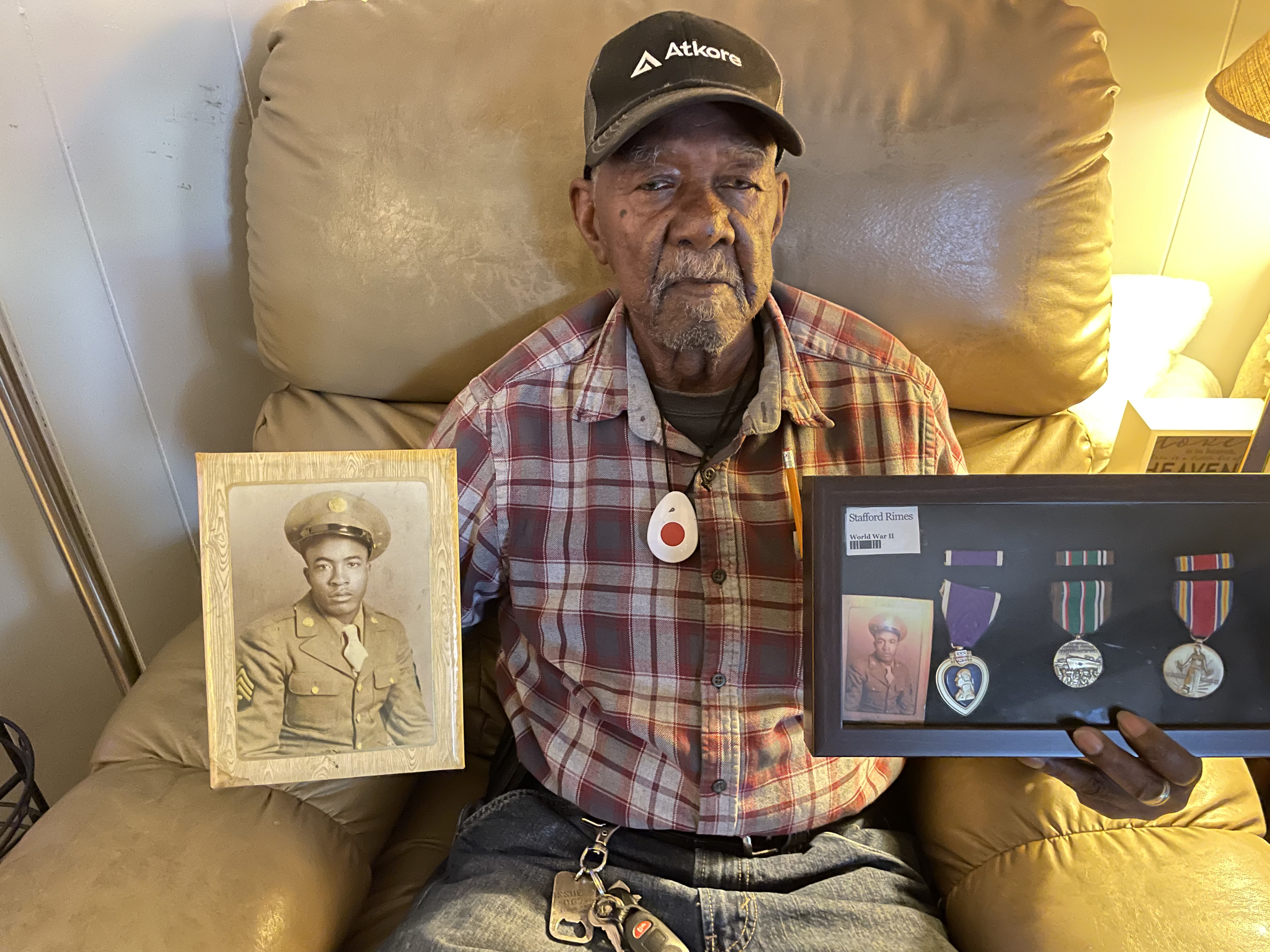
Pvt. Stafford Rimes and his brother Wilbur are part of a generation of Black soldiers who brought the Civil Rights Movement to the doorsteps of America after World War II. Stafford fueled the fire that led fellow African American Veterans in their fight for equality upon their return from war.61 He will always be remembered for his commitment to his country. Stafford’s family has never forgotten his bravery in service. His sister Geraldine and his brother James Jr., shown here, remember the older brother they have not seen since he left for war. As you can see, James Jr. still keeps the framed portrait of Stafford in uniform, along with a shadow box which contains Stafford’s medals, on his side table.62

In 2024, Florida France Soldier Stories connected Stafford Rimes’ family and historian Samuel de Korte, making it possible for Stafford’s photo to appear in de Korte’s book The 452nd Anti-Aircraft Artillery Battalion: Destroyers of the Luftwaffe and Jim Crow (2025). As you can see here, Samuel de Korte has since visited Stafford’s grave in Lorraine-American Cemetery in Saint-Avold, France to pay his respects on behalf of the Rimes family.
1 “US, World War II Draft Cards Young Men 1940-1947,” database, Ancestry.com (www.ancestry.com: accessed November 5, 2024), entry for Stafford Rimes, 34534169; “1920 US Census,” database, Ancestry.com (www.ancestry.com: accessed November 5, 2024), entry for Stafford Rimes.
2 Florida, Marriage Records, 1823-1982.” database, Ancestry.com (www.ancestry.com: accessed November 5, 2024), entry for James Rimes, Mason, Columbia County, Florida.
3 “Florida, U.S., Death Index, 1877-1998” database, ancestry (www.ancestry.com: accessed March 19, 2026, entry for Vasco Rimes; “Wilbur Rimes,” Find a Grave, June 12, 2020, accessed March 19, 2026, https://www.findagrave.com/memorial/211304938; “Erma Charpy,” Find a Grave, October 21, 2013, accessed March 19, 2026, https://www.findagrave.com/memorial/119076080; “Idabelle Rimes Williams,” Find a Grave, September 29, 2020, accessed March 19, 2026, https://www.findagrave.com/memorial/216152759; “World War II Draft Card Young Men, 1940-1947,” databas, Ancestry (www.ancestry.com: accessed March 19, 2026) entry for Coram Rimes; “1930 United States Federal Census,” databas, Ancestry (www.ancestry.com: accessed March 19, 2026) entry for J R Rimes; “Florida, Marriage Records,1823-1982,” database, Ancestry.com (www.ancestry.com: accessed November 5, 2024), entry for James Rimes, Mason, Columbia County, Florida.
4 Brenda Nedab, telephone interview by Amelia Lyons, Eric Thompson, Samantha Froemming, September 9, 2024. We wish to thank Brenda Nedab, James Rimes’ daughter, and the Rimes family for their generous assistance in telling their brother and uncle Stafford’s story.
5 Tameka Bradley Hobbs, Democracy Abroad, Lynching at Home: Racial Violence in Florida (Gainesville, Florida: University Press of Florida, 2015), 5-7; Jerrell H. Shofner, “Custom, Law, and History: The Enduring Influence of Florida’s ‘Black Code’,”The Florida Historical Quarterly, Vol. 55, no.3 (January 1977): 277-298.
6 “1910 United States Federal Census,” database, Ancestry (www.ancestry.com: accessed March 19, 2026) entry for Jasper Rimes; “1920 United States Federal Census,” database, Ancestry (www.ancestry.com: accessed March 19, 2026) entry for Jasper Rimes, “List of Men Ordered to Report to Local Board for Military Duty, 1917-1918,” database, Ancestry (www.ancestry.com: accessed March 19, 2026) entry for Jasper Rimes; “World War I Draft Registration Cards, 1917-1918,” database, Ancestry (www.ancestry.com: accessed March 19, 2026) entry for Jasper Rimes, U.S., City Directories, 1822-1995, database, Ancestry (www.ancestry.com: accessed March 19, 2026) entry for Jasper Rimes, Eusis, Florida, City Directory, 1926.
7 James L. McCorkle. “Southern Truck Growers’ Associations: Organization for Profit.” Agricultural History 72, no. 1 (1998): 77–99.
8 “Florida, US, Death Index, 1877-1998,” database, Ancestry (www.ancestry.com: accessed November 6, 2024), entry for Odella (Idella) Rimes; “Florida, Marriage Records,1823-1982,” database, Ancestry (www.ancestry.com: accessed November 5, 2024), entry for James Rimes, Mason, Columbia County, Florida.
9 “1940 US Census,” database, Ancestry.com (www.ancestry.com: accessed November 5, 2024), entry for Stafford Rimes; “Mozella Allen,” Find a Grave, February 27, 2021, accessed March 19, 2026, https://www.findagrave.com/memorial/223622945; “Randolph Rimes,” Find a Grave, September 25, 2010, accessed March 19, 2026, https://www.findagrave.com/memorial/59194824; “U.S., Cemetery and Funeral Home Collection,” database, Ancestry (www.ancestry.com: accessed November 5, 2024), entry Hazel D. Rimes; “1950 US Census,” database, Ancestry (www.ancestry.com: accessed November 5, 2024), entry for Geraldine Rimes.
10 “Florida, U.S., Wills and Probate records, 1827-1950,” database, Ancestry (www.ancestry.com: accessed November 6, 2024), entry for Jasper Rimes,“1940 US Census,” database, Ancestry (www.ancestry.com: accessed November 5, 2024), entry for Idella Rimes.
11 “Florida, US, Death Index, 1877-1998,” database, Ancestry (www.ancestry.com: accessed November 6, 2024), entry for Idella Rimes; Brenda Nedab, telephone interview by Amelia Lyons, Eric Thompson, Samantha Froemming, September 9, 2024.
12 “The Citrus Industry in Florida,” Florida Division of Historical Resources, accessed November 5, 2024. https://dos.fl.gov/historical/museums/historical-museums/united-connections/foodways/food-cultivation-and-economies/the-citrus-industry-in-florida/
13 Brenda Nedab, telephone interview by Amelia Lyons, Eric Thompson, Samantha Froemming, September 9, 2024
14 The Lake Training School in Leesburg, Florida was an all-black school that opened in 1876. Despite multiple relocations and name changes, the school maintained its importance in Leesburg and transformed into an elementary school. The school remained in operation until 2008, when it was sold and demolished. For more information on Lake Training School, see “A History of Dabney Elementary,” The Daily Commercial, accessed November 6, 2024. https://www.dailycommercial.com/story/news/local/leesburg/2019/04/30/now-and-then-dabney-schools-132-year-history-in-leesburg/5304842007/ ; Brenda Nedab, telephone interview by Amelia Lyons, Eric Thompson, Samantha Froemming, 9 September 2024; Stafford is listed as “student” on the 1935 Florida Census. “1935 Florida Census,” database, Ancestry (www.ancestry.com: accessed November 5, 2024), entry for Stafford Rimes.
15 “1935 Florida, U.S., State Census,“ database, Ancestry (www.ancestry.com: accessed March 19, 2026), entry for Stafford Rimes; “1940 US Census,” database, Ancestry (www.ancestry.com: accessed March 19, 2026), entry for Stafford Ryan; “US, World War II Draft Cards Young Men 1940-1947,” database, Ancestry (www.ancestry.com: accessed March 19, 2026) entry for Stafford Rimes; “US, World War II Draft Cards Young Men 1940-1947,” database, Ancestry (www.ancestry.com: accessed March 19, 2026) entry for Wilbur Rimes; “US, World War II Draft Cards Young Men 1940-1947,” database, Ancestry (www.ancestry.com: accessed March 19, 2026) entry for Vasco Rimes; “US, World War II Army Enlistment Records,” database, Ancestry (http://www.ancestry.com: accessed November 5, 2024,) entry for Stafford Rimes, 34534169.
16 For more on the history of gas stations see : https://www.smithsonianmag.com/smart-news/short-picture-history-gas-stations-180967337; https://aoghs.org/transportation/first-gas-pump-and-service-stations
17 “US, World War II Draft Cards Young Men 1940-1947” entry for Stafford Rimes; “US, World War II Draft Cards Young Men 1940-1947,” entry for Wilbur Rimes; “US, World War II Draft Cards Young Men 1940-1947,” entry for Vasco Rimes.
18 “US, World War II Army Enlistment Records,” entry for Stafford Rimes; Brenda Nedab, telephone interview with Amelia Lyons, Eric Thompson, and Samantha Froemming, 9 September 2024. Stafford’s enlistment records from December 1942 indicate that he filed as single with dependents, suggesting that he may have had a partner and a child. His niece Brenda confirmed that the family thinks he lived with the mother of his child at the time he joined the US Army.
19 “US, World War II Army Enlistment Records,” entry for Stafford Rimes; “US, World War II Army Enlistment Records,” database, Ancestry (www.ancestry.com: accessed March 19, 2026) entry for Wilbur Rimes.
20 Ulysses Lee, The Employment of Negro Troops (Washington D.C.: Office of the Chief of Military History, US Army, 1966), 13-14, 111-112; Bryon Greenwald, “Absent from the Front: What the Case of the Missing World War II Black Combat Soldier Can Teach Us About Diversity and Inclusion,” Joint Force Quarterly III (October 30, 2023): https://www.researchgate.net/publication/375519926
21 Mathew Delmont, Half-American; The Epic Story of African Americans Fighting World War II at Home and Abroad (New York: Viking, an imprint of Penguin Random House LLC), 101-112, 189-201.
22 “African American Service and Racial Integration in the US Military” US Army, accessed November 6, 2024. https://www.army.mil/article/243604/african_american_service_and_racial_integration_in_the_u_s_military#
:~:text=During%20World%20War%20II%2C%20over,Army%20and%20Army%20Air%20Corps.
23 “Headstone and Internment Records,” database, Ancestry (www.ancestry.com: accessed November 5, 2024), entry for Stafford Rimes, service number 34534169.Bryon Greenwald, “Absent from the Front”; “Black History Month: Honoring the Past, Securing the Future,” Defense Logistics less Agency, accessed November 6, 2025.
24 Alexander Bielawkowski, Proud Warriors: African American Combat Units in World War II (Denton, Texas: University of North Texas Press), 130-131.
25 Alexander Bielawkowski, Proud Warriors, 130-131.
26 Alexander Bielawkowski, Proud Warriors, 140; Shelby L. Stanton, Order of Battle, US Army, World War II (Novato, California: Presidio Press, 1984), 499, 597.
27 William L. O’Neill, A Democracy at War: America’s Fight at Home and Abroad in World War II (New York: Macmillan, 1993), 239; Lee, “Chapter XII: Harvest of Disorder” in The Employment of Negro Troops.
28 Stanton, Order of Battle, 597.
29 Portrait of Stafford Rimes in Uniform, Rimes Family Archives, c. 1943. We are grateful to James Rimes Jr. and Brenda Nedab, Stafford’s brother and niece, for allowing us to publish the family photos. We are not sure why he is wearing a Tech 5 uniform in the photograph as all archival sources and his headstone indicate that Stafford never got promoted and remained a Private during his military service. While most African Americans served as privates and privates first class in the Army, Black units had higher ranking enlisted men and officers. He may have borrowed a dress uniform from a comrade who had been promoted due to specific technical skills, like the ability to drive a truck.
30 Stanton, Order of Battle, 499; Bielawkowski, Proud Warriors, 140.
31 “US, WWII Hospital Admission Card Files, 1942-1954,” database, Ancestry (www.ancestry.com: accessed November 5, 2024), entry for Stafford Rimes, 34534169.
32 For more information on the 761st Tank Battalion see Craig A. Trice, “The Men That Served with Distinction: ‘The 761st Tank Battalion,’” (M.A. diss, US Army Command and General Staff College, 1997) and the biographies of Samuel Wood and Clifford Adams on this same Florida France Soldier Stories website.
33 Bryon Greenwald, “Absent from the Front” (October 30, 2023).
34 Samuel de Korte. The 452nd Anti-Aircraft Artillery Battalion: Destroyers of the Luftwaffe and Jim Crow. Yorkshire, United Kingdom: Pen & Sword Military, 2025, 71-72. We wish to thank Samuel de Korte for his generous assistance in telling Stafford’s story and his willingness to share his archival research with us now and in the future.
35 The other all-black battalion to employ a Bofors 40-mm anti-aircraft gun was the 320th Barrage Balloon Battalion. Bryon Greenwald, “Absent from the Front: What the Case of the Missing World War II Black Combat Soldier Can Teach Us About Diversity and Inclusion,” in Joint Force Quarterly III (October 30, 2023): https://ndupress.ndu.edu/Media/News/News-Article-View/Article/3571057/#:~:text=Besides%20the%20320th%20Barrage,artillery%20units%20during%20this%20period; “Black History Month: Honoring the Past, Securing the Future,” Defense Logistics Agency, accessed November 6, 2024 https://www.dla.mil/About-DLA/News/News-Article-View/Article/2491590/black-history-month-honoring-the-past-securing-the-future/; Lee, The Employment of Negro Troops, 13-14, 111-112.
36 Bielawkowski, Proud Warriors, 140; “US Army Central Timeline: World War II,” US Army Central, accessed November 5, 2024. https://www.usarcent.army.mil/About/History/Timeline/
37 de Korte. The 452nd Anti-Aircraft Artillery Battalion: Destroyers of the Luftwaffe and Jim Crow, 75-7.
38 de Korte. The 452nd Anti-Aircraft Artillery Battalion: Destroyers of the Luftwaffe and Jim Crow, 85-87.
39 Bielawkowski, Proud Warriors, 140; “US Army Central Timeline: World War II,” US Army Central ; Samuel de Korte. The 452nd Anti-Aircraft Artillery Battalion: Destroyers of the Luftwaffe and Jim Crow, 87-120.
40 The 452nd participation was noted in a New Pittsburgh Courier article in December 1944, “Gunners Fire on Pillboxes,” The New Pittsburgh Courier (Pittsburgh, Pennsylvania), December 16, 1944, Newspapers.com; Samuel de Korte. The 452nd Anti-Aircraft Artillery Battalion: Destroyers of the Luftwaffe and Jim Crow, 98.
41 “US, WWII Hospital Admission Card Files, 1942-1954,” database, Ancestry (www.ancestry.com: accessed November 5, 2024), entry for Stafford Rimes, 34534169; “Headstone and Internment Records,” database, Ancestry (www.ancestry.com: accessed November 5, 2024), entry for Stafford Rimes, service number 34534169; US Army Central Timeline: World War II,” US Army Central; “US, WWII Hospital Admission Card Files, 1942-1954,” entry for Stafford Rimes.
42 “US, WWII Hospital Admission Card Files, 1942-1954,” entry for Stafford Rimes; Stafford Rimes, OMPF, NARA. We are also grateful to Samuel de Korte for sharing Stafford’s military records, which he digitized at the US National Archives.
43 Alexander Bielawkowski, Proud Warriors, 141.
44Alexander Bielawkowski, Proud Warriors, 141; Shelby L. Stanton, Order of Battle, 499.
45 “Foxfoles Fade Colorlines,” The Austin American-Statesman (Austin, Texas), November 16, 1944, Newspapers.com; “No Color Line in a Foxhole,” The Sioux City Journal (Sioux City, Iowa), November 19, 1944, Newspapers.com; “22 Tan Combat Units Fought Against Nazis,” The St. Louis Argus (St. Louis, Missouri), August 17, 1945, Newspapers.com.
46 “Stafford Rimes,” American Battle Monuments Commission, accessed November 5, 2024. https://www.abmc.gov/decedent-search/rimes%3Dstafford
47 Letter from Major General E. Feldman, Quartermaster General, US Army, to Mr. James Rimes, April 29 1949. Stafford Rimes OMPF, NARA. Our thanks to Samuel de Korte for sharing these records.
48 “Stafford Rimes,” American Battle Monuments Commission, accessed November 5, 2024. https://www.abmc.gov/decedent-search/rimes%3Dstafford
49 “Florida Service Casualties are Listed by Army,” The Bradenton Herald (Bradenton, Florida), February 14, 1945, Newspapers.com. We rarely find mention of African American servicemen in Florida’s white press during the war.
50 “Wilbur Rimes,” Find a Grave (https: //findagrave.com; accessed March 31, 2026), memorial 211304938, Wilbur Rimes; “Department of Veteran Affairs BIRLS death File, 1850-2020,” database, Ancestry (www.ancestry.com, accessed March 31, 2026), entry for Wilbur Rimes.
51 “1950 US Census,” database, Ancestry (www.ancestry.com: accessed November 5, 2024), entry for Wilbur Rimes.
52 “Wilbur Rimes Sr.” The Orlando Sentinel (Orlando, Florida), January 30, 1988, Newspaper.com; “Wilbur Rimes,” Find a Grave.
53 Brenda Nedab, telephone interview by Amelia Lyons, Eric Thompson, Samantha Froemming, 9 September 2024. Sadly, the family lost Sadie Rimes on October 8, 2023.
54 Brenda Nedab, telephone interview by Amelia Lyons, Eric Thompson, Samantha Froemming, 9 September 2024.
55 “The Great Migration (1910-1970),” National Archives, accessed November 5, 2024, https://www.archives.gov/research/african-americans/migrations/great-migration; For more information on the Great Migration, see Isabel Wilkerson, The Warmth of Other Suns (New York: Penguin Random House, 2010).
56 Brenda Nedab, telephone interview by Amelia Lyons, Eric Thompson, Samantha Froemming, 9 September 2024.
57 “Freedom never dies; Florida Terror: Groveland,” PBS, November 5, 2024, accessed on November 22, 2024, https://www.pbs.org/harrymoore/terror/groveland.html
58 The Groveland Four were posthumously exonerated from the criminal charges by the state of Florida in 2021. The events surrounding their cases were described as a “complete breakdown of the criminal justice system” by a Florida prosecutor in a New York Times article. For more information see “Four Black Men Wrongly Charged With Rape Are Exonerated 72 Years Later,” The New York Times Magazine, November 22, 2021, https://www.nytimes.com/2021/11/22/us/groveland-four-exonerated-florida.html ; “Harry T. and Harriette Moore,” NAACP, accessed November 5, 2024. https://naacp.org/find-resources/history-explained/civil-rights-leaders/harry-t-and-hariette-moore
59 Joe Rimes Plaque, Rimes Family Archives, undated. We would like to thank James Rimes Jr. and Brenda Nedab, Stafford’s brother and niece, for allowing us to publish the family photos.
60 Brenda Nedab, telephone interview by Amelia Lyons, Eric Thompson, Samantha Froemming, 9 September 2024.
61 Gary R. Mormino, “GI Joe Meets Jim Crow: Racial Violence and Reform in World War II Florida.” The Florida Historical Quarterly 73, no. 1 (1994): 23-42, 40-42.
62 Stafford Rimes is the first African American soldier to be identified in a photo in the Florida France Soldier Stories project; Brenda Nedab, telephone interview by Amelia Lyons, Eric Thompson, Samantha Froemming, 9 September 2024; Portrait of Stafford Rimes in US Army Uniform Held By James Rimes Jr., Rimes Family Archives, undated. We are grateful to James Rimes Jr. and Brenda Nedab, Stafford’s brother and niece, for allowing us to publish the family photos.
© 2026, University of Central Florida