PVT. First Class Willie L. Dumas (July 25, 1925 – May 17, 1945)
791st Engineer Dump Truck Company
Written by Tanner Cairns
Early life
Willie L. Dumas was born July 25, 1925, in Jacksonville, FL.1 He grew up with his mother, Hattie Dumas. Hattie, born in Georgia, moved to Florida before the birth of her son Oscar in 1916.2 Hattie left Georgia during the era of the Great Migration, when millions of Black Americans moved seeking greater opportunities. The majority of African Americans moved out of the South entirely, seeking better conditions in Northern cities like Chicago, Philadelphia, and New York. Yet, some families moved within the South, particularly to areas with economic opportunity. Jacksonville faced a mass exodus of African Americans during the Great Migration, but its role as a transportation hub meant there was still demand for workers, and some Black community leaders rallied together to slow this exodus, with newspaper articles urging community members to stay in place and the city council passing ordinances that would fine recruiters for out-of-state businesses. In 1917, Florida’s newly inaugurated governor, Sidney Catts, promised to work with Black leaders to improve conditions and was instrumental in creating the Division of Negro Economics, which sought to balance the needs of the local economies with the demands of the war effort during the First World War. While Jacksonville and other North Florida communities broadly lost residents to the Great Migration, there was enough movement and job demand that some individuals came to these areas from other locales where opportunities and conditions may have been even worse.3
Hattie worked hard to take care of Oscar and, a few years later, Willie. By 1930, Hattie worked as an at-home laundress.4 In 1935, as seen here on the census, Hattie worked as a housekeeper, while Oscar worked as a bellboy and Willie attended first grade. Fred Willis, a cousin, lived with the Dumas family as a lodger for over a decade, likely to provide additional financial support for running the home.5
Jacksonville, like most communities throughout the urban South, enforced deep segregation. By 1945, African Americans accounted for more than forty-five percent of Duval County’s population.6
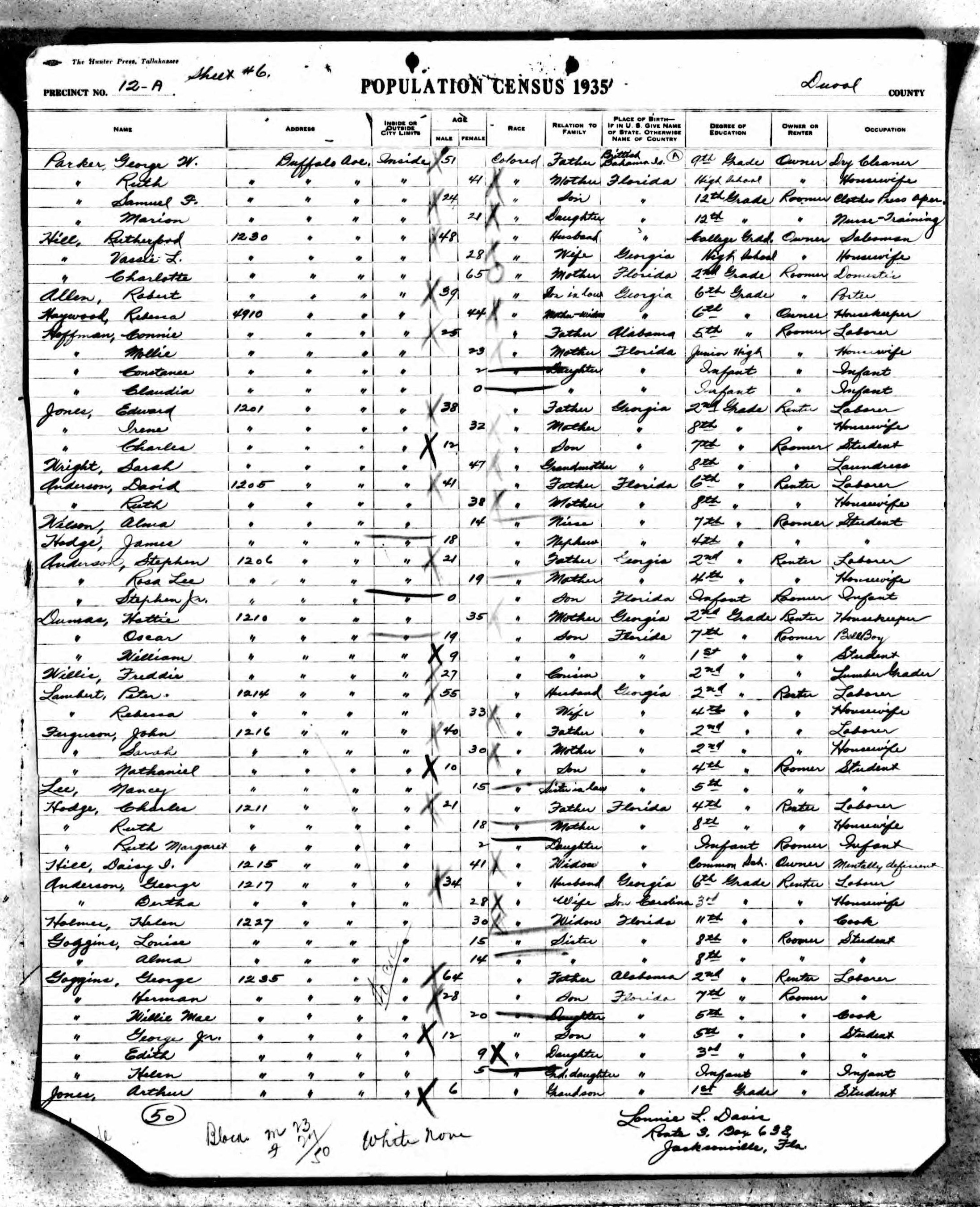
The Dumas family lived on Buffalo Avenue in Panama Park, a neighborhood “redlined” in northwest Jacksonville near the confluence of the Trout and St. Johns Rivers.7 A nearby sawmill and rail lines demanded laborers for grueling work, and the family’s lodger, Fred, likely found work at the sawmill.8 By the time of his draft registration in 1941, shortly after his eighteenth birthday, Willie worked on a railway extra gang for the Seaboard Railroad.9 Labor tensions ran high on the rails as companies rapidly introduced mechanized equipment that threatened to replace many gangmen. Competition from the expanding highway network intensified the strain. As ridership declined, profits fell, and companies pushed to keep wages low. Railroads across the South relied heavily on African American labor, and by 1930, nearly 120,000 Black Americans worked in the industry.10 Black laborers often worked the least desirable–the hardest or most dangerous–jobs in many industries, and the rail industry was no different. Members of the extra gang, like Willie, usually lived in semi-permanent camps along the rail route, ready to mobilize to repair the rail line as needed. This was physically demanding work, including moving heavy rail ties and repairing broken iron rail lines under time pressure to minimize potential downtime.11
The railroad and transportation industry is inextricably tied to Black Americans’ efforts to secure greater rights. In Jacksonville, African Americans had staged protests and boycotts of segregated rail and streetcar networks dating back to the turn of the century. On multiple occasions, railway laborers petitioned the government for intervention or took to the picket line to protest falling wages. Also in Jacksonville, some Black communities that felt underserved by existing infrastructure established streetcar lines to serve predominantly Black neighborhoods. The North Jacksonville Line was one such streetcar service that served a neighborhood not unlike the one in which Willie grew up. While it was still segregated due to existing Jim Crow laws, the whites-only section was in the rear, and the Black-only section was at the front, inverting the traditional structure of other segregated transportation networks.12 Pullman porters, traditionally Black train attendants, provided a major source of news for African Americans, as their positions and movement across the country empowered them to gather and circulate news and information. The porters served as the early leaders in civil rights and labor movements; they successfully established an all-Black labor union in 1937.13
Military Service
Private Willie Dumas enlisted on October 2, 1943, and trained at Camp Blanding, FL less than forty miles from the Jacksonville area.14 After completing his training, Willie became a member of the 791st Engineer Dump Truck Company, a segregated, African American service unit.15
Racism and segregation in the US played a significant role in shaping the everyday lives of African Americans, and continued to play a role in Black soldiers’ experiences while in service during World War II. Across the American South, African Americans protested racial inequality through work stoppages and rumored uprisings, while white mobs and authorities often responded with violent retaliation, including dozens of lynchings. Tallahassee witnessed multiple riots involving black servicemen and white civilians supported by the local police. Unclassified documents prepared by the Army Service Forces revealed riot response plans in Florida in the event of renewed race riots. The plans included imposing martial law in major Florida cities, including Tallahassee, Jacksonville, Miami, Orlando, Tampa, and St. Petersburg. Although the “renewed” riots did not occur in these areas, the potential for racial violence shaped the implementation of later policies, and the discovery of riot response protocols revealed the effects of systemic racism at home during the war.16
The 791st Engineer Dump Truck Company, an all-Black service unit, hauled resources and cleared debris along supply lines while maintaining roads and railways, key arteries that enemy bombing raids frequently targeted. Most all-Black units, including the 791st, served in non-combat and non-technical roles, continuing the same pattern of assignments established during World War I, and always in demand because of their essential role in securing and maintaining supply routes.17 Willie’s assignment to the 791st Engineer Dump Truck Company likely resulted from his work on a railroad extra gang, giving him hands-on experience that closely matched his unit’s duties.
In the winter of 1944, the 791st joined the 1321st Engineer General Service Regiment, another segregated unit attached to the Seventh Army; it built and maintained supply lines and infrastructure across eastern France. On December 27, the 791st, alongside the 46th and 28th Quartermaster Truck Groups, helped evacuate valuable enemy material captured from German depots in Strasbourg, Obernai, and Russ–all in German annexed eastern France. General Eisenhower contemplated pulling the Seventh back from the Alsace region under pressure from German advances. On January 3, 1945, however, General de Gaulle, with Churchill’s support, confronted Eisenhower and demanded that the Allies continue fighting for Alsace. Eisenhower ultimately decided to hold the region, placing the service units, including Willie’s, into danger, exposing them to strafing runs and clashes with German patrols as they worked ahead of the newly established lines.18
Then, during the Allied spring offensive in March 1945, the 791st and the other service units attached to the 1321st moved to Sarreboug, about forty miles from Strasbourg on the western side of the Vosges Mountains, which the Seventh Army had taken for the second time. The companies rebuilt major roads, operated water points, and constructed pipelines in Blâmont, Sarrebourg, and Saverne in northeastern France. In April 1945, they opened a main supply route between Karlsruhe, about twenty miles from the border between Germany and France, and Stuttgart, the capital of Germany’s Baden-Bürttenberg region, to bolster the Seventh Army’s final push toward Munich. This immense undertaking required these American service units to rebuild areas that both Allied bombings and retreating German forces had heavily damaged.19
At some point during his service, Willie rose to the rank of Private First Class.20 While we are not sure what led to this recognition, his experience on the railroad likely sharpened the skills he applied in the Army.21 In the immediate postwar period, the 791st helped rebuild France, focusing on rebuilding roads and bridges with other dump truck companies.22 The unit likely operated in an area south of Paris that had been liberated for over eight months. On May 17th, 1945, less than two weeks after Victory in Europe Day, Private First Class Willie L. Dumas died in a non-battle incident.23 The Army buried him temporarily in Melun, about thirty miles southeast of Paris.24 Willie was nineteen years old.
Legacy
In March 1946, President Harry S. Truman signed an executive order that tasked the American Battle Monuments Commission (ABMC) with creating permanent World War II cemeteries and memorials outside the US. This decision led to the selection of Dinozé as the site of the Epinal American Cemetery.
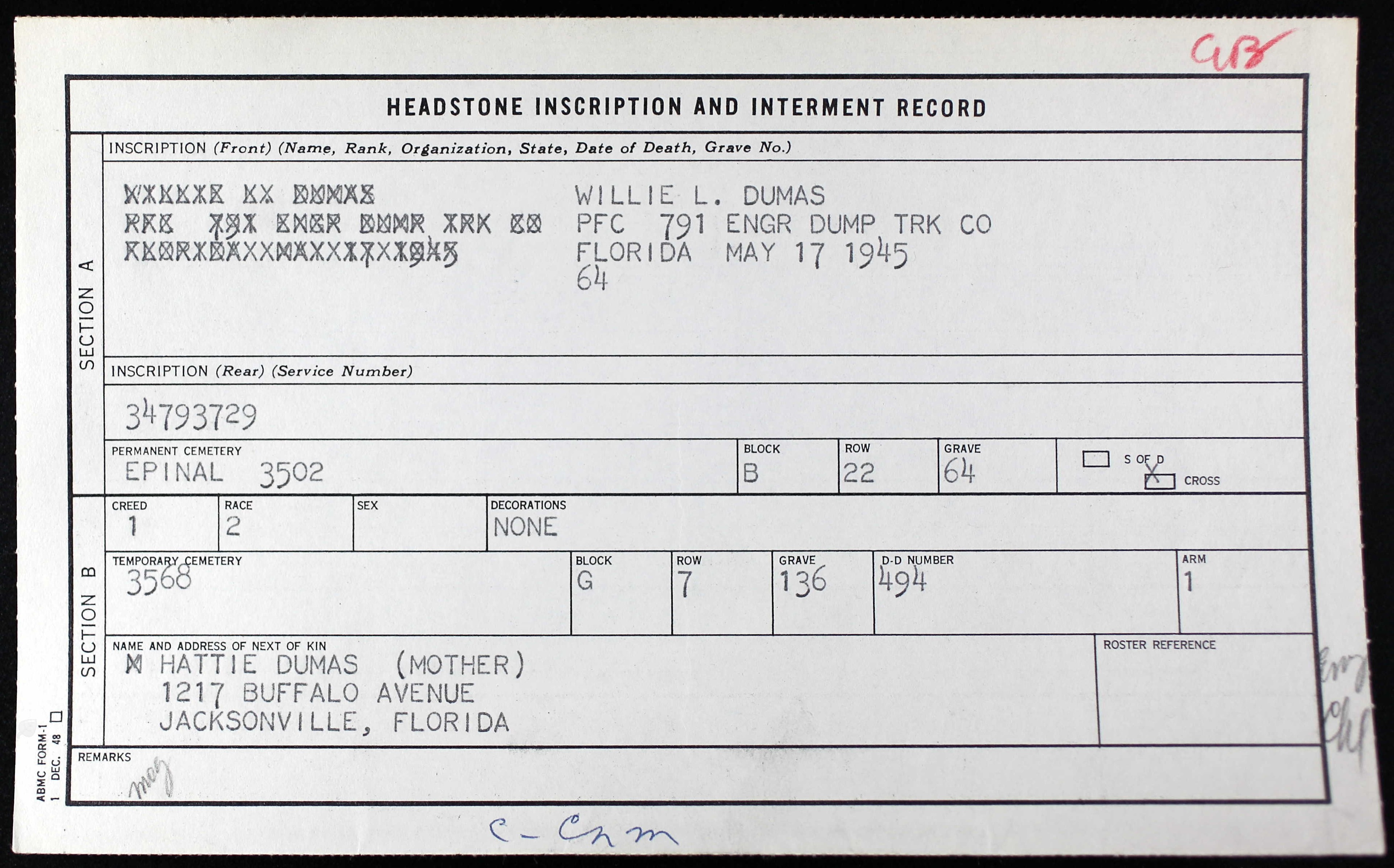
Willie’s mother, Hattie, seen here as next of kin on his headstone and internment record , chose that he be laid to rest among his fellow soldiers in the Epinal American Cemetery, in block B, row 22, grave 64.25 After the war, Hattie, who retired in her early sixties, continued to reside in Jacksonville until her death in October of 1967, at the age of 78.26
Private First Class Willie L. Dumas and the 791st Engineer Dump Truck Company, along with over one million African Americans who served in World War II, answered the call to defend a country that still denied them full equality.27 These inspirational men and women paved the way for future generations to advance civil rights in the post-war era. During the war, African American service members embraced the “Double-V Campaign,” inspired by a 1942 letter to the editor in the Pittsburgh Courier that highlighted the struggle of fighting for freedom abroad while lacking it at home. Black soldiers sought two victories during World War II: one against enemies overseas, and another against racial injustice in the United States.28 Colonel Aldo Bagnulo, a white officer of the 1321st Engineer General Service Regiment, a primarily black unit to which the 791st Dump Truck Company was attached, praised the men he led, noting that his men “[All] throughout its career made up for lack of experience and skills by a desire to do [their] best in any assigned task, big or small.”29 Willie Dumas will always be remembered for his bravery and sacrifice in service. His legacy as an African American soldier will forever be connected to the continued achievements of fellow service members who came home and joined the fight for equality in the US after fighting overseas
1 “U.S. WWII Draft Registration Card,” Database, Ancestry (www.ancestry.com: accessed February 7, 2023), entry for Willie L. Dumas, service number 34793729
2 “1930 U.S. Census,” Database, Ancestry (www.ancestry.com: accessed January 31, 2023), entry for Hattie Dumas, Jacksonville, Duval County, Florida; “1935 Florida State Census,” Database, Ancestry (www.ancestry.com: accessed January 19, 2023), entry for Willie Dumas, Jacksonville, Duval County, Florida.
3 See Isabel Wilkerson, The Warmth of Other Suns (New York: Penguin Random House, 2010) and Jerrell H. Shofner, “Florida and the Black Migration,” The Florida Historical Quarterly 57, no. 3 (1979): 267–88.
4 “1930 U.S. Census,” Database, Ancestry (www.ancestry.com: accessed January 31, 2023), entry for Willie Dumas, Jacksonville, Duval County, Florida.
5 “1935 Florida State Census,” Database, Ancestry (www.ancestry.com: accessed January 19, 2023), entry for Willie Dumas, Jacksonville, Duval County, Florida.
6 Robert Cassanello, To Render Invisible: Jim Crow and Public Life in New South Jacksonville. Gainesville: University Press of Florida, 2016, 139.
7 Redlining refers to a discriminatory practice in which banks, insurers and government agencies refused or limited services in certain neighborhoods based on race or ethnicity. “Jacksonville Street Index,” H. Pope Neff, Division of Research & Statistics – H.O.L.C., January 11, 1937.
8 “1940 U.S. Census,” Database, Ancestry (www.ancestry.com: accessed February 7, 2023), entry for Willie Dumas, Jacksonville, Duval County, Florida.
9 “U.S. World War II Army Enlistment Records,” Database, Fold3 (www.fold3.com: accessed January 8, 2023), entry for Willie L. Dumas, Service Number 34793729.
10 Charles S. Johnson, “Negroes in the Railway Industry,” Phylon (1940-1956) 3, no. 1 (1942): 5.
11 Eric Arnesen, Brotherhoods of colors, Black Railroad workers and the Struggle for Equality, Cambridge, Harvard University Press, 2002, 5-149.
12 Cassanello. To Render Invisible, 100, 118, 98.
13 “Pullman Porters: From Service to Civil Rights.” National Railroad Museum, last modified May 2, 2022, accessed January 8, 2023, https://nationalrrmuseum.org/pullman-porters-from-service-to-civil-rights/.
14 “U.S. World War II Army Enlistment Records,” Database, Fold3 (www.fold3.com: accessed January 8, 2023), entry for Willie L. Dumas, Service Number 34793729.
15 “Headstone Inscription and Internment Records,” Database, Ancestry (www.ancestry.com: accessed February 7, 2023), entry for Willie L. Dumas, service number 34793729.
16 Gary R. Mormino. “Gi Joe Meets Jim Crow: Racial Violence and Reform in World War II Florida.” The Florida Historical Quarterly 73, no. 1 (1994): 23–42.
17 Ulysses Lee, The Employment of Negro Troops (Washington D.C.: Office of the Chief of Military History, US Army, 1966), 593.
18 Aldo H. Bagnulo. Nothing But Praise (Office of History, Headquarters, U.S. Army Corps of Engineers, 2009), 6, 44.
19 Bagnulo. Nothing But Praise, 6, 44, 54-56.
20 “Headstone Inscription and Internment Records,” entry for Willie L. Dumas.
21 “U.S. World War II Army Enlistment Records,” entry for Willie L. Dumas,
22 Ulysses Lee, The Employment of Negro Troops, 593, 632-633.
23 “U.S. WWII Casualty List,” Database, Ancestry (www.ancestry.com: accessed February 7, 2023), entry for Willie Dumas, Jacksonville, Duval County, Florida, service number 34793729.
24 Burial code “3568” on Willie’s internment record indicated his temporary burial location in Solers Cemetery, Melun, France; “Headstone Inscription and Internment Records,” entry for Willie L. Dumas.
25 “U.S. World War II Army Enlistment Records,” entry for Willie L. Dumas; American Battle Monument Commission, “As the World War II ends in Europe, ABMC’s mission is renewed,” last modified May 8, 2025, accessed April 20, 2026, https://www.abmc.gov/news-events/news/as-world-war-ii-ends-in-europe-abmcs-mission-is-renewed/
26 “1950 U.S. Census,” Database, Ancestry (www.ancestry.com: accessed January 29, 2023), entry for Hattie Dumas, Jacksonville, Duval County, Florida; “1877-1998 Death Index.” Database, Ancestry. (www.ancestry.com: accessed April 26, 2023), entry for Hattie Dumas, Jacksonville, Duval County, Florida.
27 Tyler Bamford,. “African Americans Fought for Freedom at Home and Abroad during World War II,” The National WWII Museum: New Orleans, January 31, 2020, accessed January 8, 2023, https://www.nationalww2museum.org/war/articles/african-americans-fought-freedom-home-and-abroad-during-world-war-ii.
28 James G. Thompson, “Should I Sacrifice to Live ‘Half-American?,” The Pittsburgh Courier, January 31, 1942.
29 Aldo H. Bagnulo. Nothing But Praise, 72
©2026, University of Central Florida